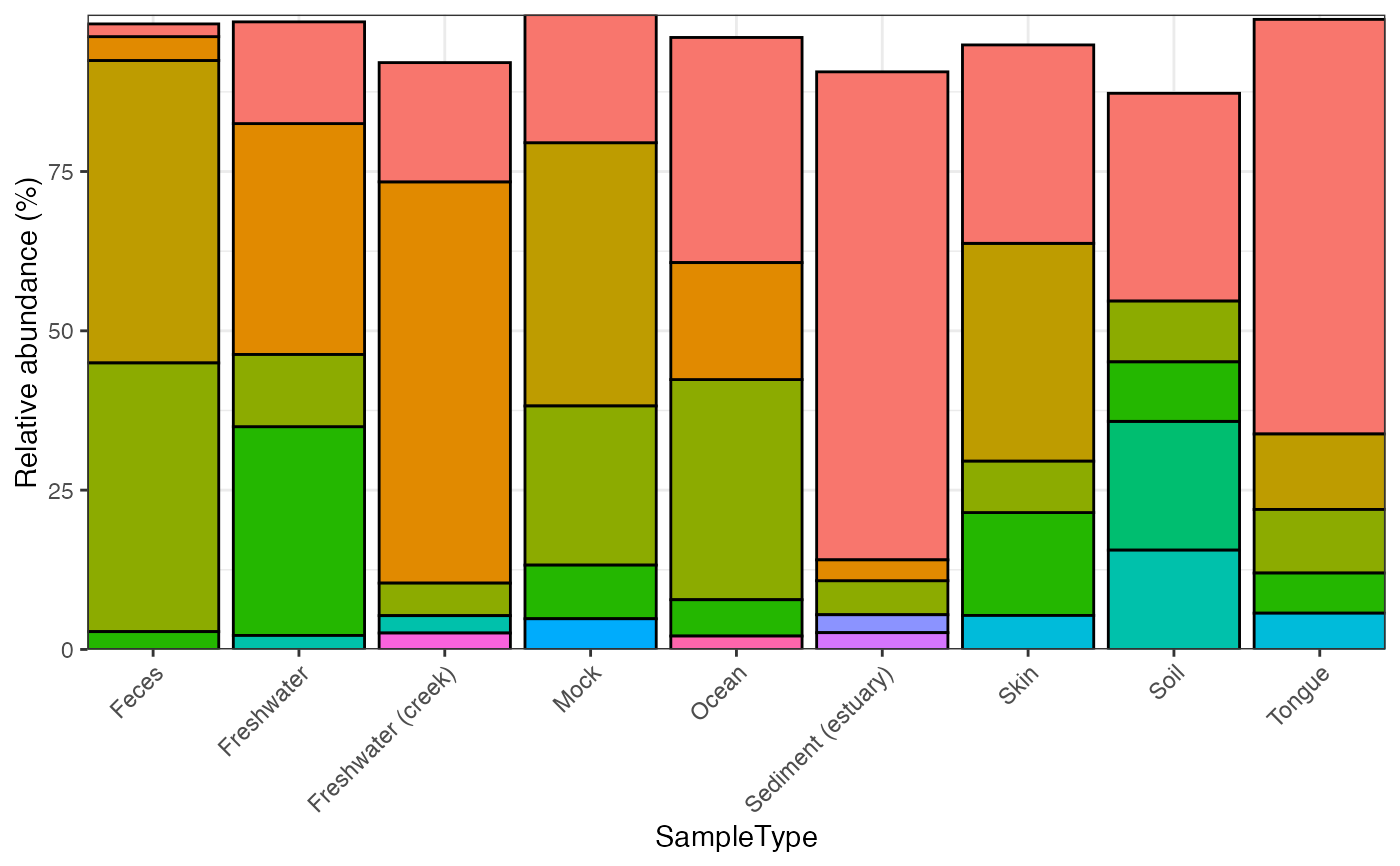
Barplot based on ggplot2
Usage
plot_barplot(
  object,
  fill = c("Kingdom", "Phylum", "Class", "Order", "Family", "Genus", "Species"),
  top_n = 5,
  show.legend,
  what = c("sum_intensity", "mean_intensity", "median_intensity"),
  na.rm = TRUE,
  relative = TRUE,
  re_calculate_relative = FALSE,
  x = "sample_id",
  color = "balck",
  facet_grid,
  ...
)

# S3 method for class 'microbiome_dataset'
plot_barplot(
  object,
  fill = c("Kingdom", "Phylum", "Class", "Order", "Family", "Genus", "Species"),
  top_n = 5,
  show.legend,
  what = c("sum_intensity", "mean_intensity", "median_intensity"),
  na.rm = TRUE,
  relative = TRUE,
  re_calculate_relative = FALSE,
  x = "sample_id",
  color = "balck",
  facet_grid,
  ...
)
Arguments
- object
microbiome_dataset
- fill
fill for barplot
- top_n
default is 5
- show.legend
show.legend or not
- what
which you want to mutate
- na.rm
na.rm
- relative
relative intensity or not.
- re_calculate_relative
re-calculate relative abundance or not.
- x
x axis
- color
color for barplot
- facet_grid
facet_grid
- ...
other params
Examples
data("global_patterns", package = "microbiomedataset")

p <- plot_barplot(
  object = global_patterns,
  fill = "Phylum",
  top_n = 5,
  x = "SampleType"
)
p