
Trees, sequences, and interoperability
Xiaotao Shen xiaotao.shen@outlook.com
2026-03-04
Source:vignettes/filtering.Rmd
filtering.RmdThis article focuses on the microbiome-specific attachments that live beside the main abundance matrix.
library(microbiomedataset)
data("global_patterns", package = "microbiomedataset")

object <- convert2microbiome_dataset(convert2phyloseq(global_patterns))
object
#> --------------------
#> microbiomedataset version: 0.99.1
#> --------------------
#> 1.expression_data:[ 19216 x 26 data.frame]
#> 2.sample_info:[ 26 x 8 data.frame]
#> 3.variable_info:[ 19216 x 8 data.frame]
#> 4.sample_info_note:[ 8 x 2 data.frame]
#> 5.variable_info_note:[ 8 x 2 data.frame]
#> --------------------
#> Processing information (extract_process_info())
#> create_microbiome_dataset ----------
#>             Package               Function.used                Time
#> 1 microbiomedataset create_microbiome_dataset() 2026-03-04 20:42:42
Work with trees
Inspect tree data in tabular form:
tree_table <- melt_tree(object, tree = "taxa_tree")
head(tree_table[, 1:6])
#>        tree parent node label   nodeClass nodeDepth
#> 1 taxa_tree  21916    1 14368 variable_id         8
#> 2 taxa_tree  21916    2 14369 variable_id         8
#> 3 taxa_tree  21916    3 14370 variable_id         8
#> 4 taxa_tree  21916    4 14371 variable_id         8
#> 5 taxa_tree  21916    5 14372 variable_id         8
#> 6 taxa_tree  21916    6 14373 variable_id         8
The object also stores explicit feature-to-tree links:
taxa_link <- extract_tree_link_data(object, tree = "taxa_tree")
head(taxa_link)
#>   variable_id  node                  node_label      tree link_rank
#> 1      549322 19345             c__Thermoprotei taxa_tree     Class
#> 2      522457 19345             c__Thermoprotei taxa_tree     Class
#> 3         951 22594 s__Sulfolobusacidocaldarius taxa_tree   Species
#> 4      244423 19343                    c__Sd-NA taxa_tree     Class
#> 5      586076 19343                    c__Sd-NA taxa_tree     Class
#> 6      246140 19343                    c__Sd-NA taxa_tree     Class

check_tree_link(object, tree = "taxa_tree")
#>        tree has_tree has_link n_links linked_variables uncovered_variables
#> 1 taxa_tree     TRUE     TRUE   19216            19216                   0
#>   invalid_nodes duplicated_variables
#> 1             0                    0
plot_tree_link(object, tree = "taxa_tree")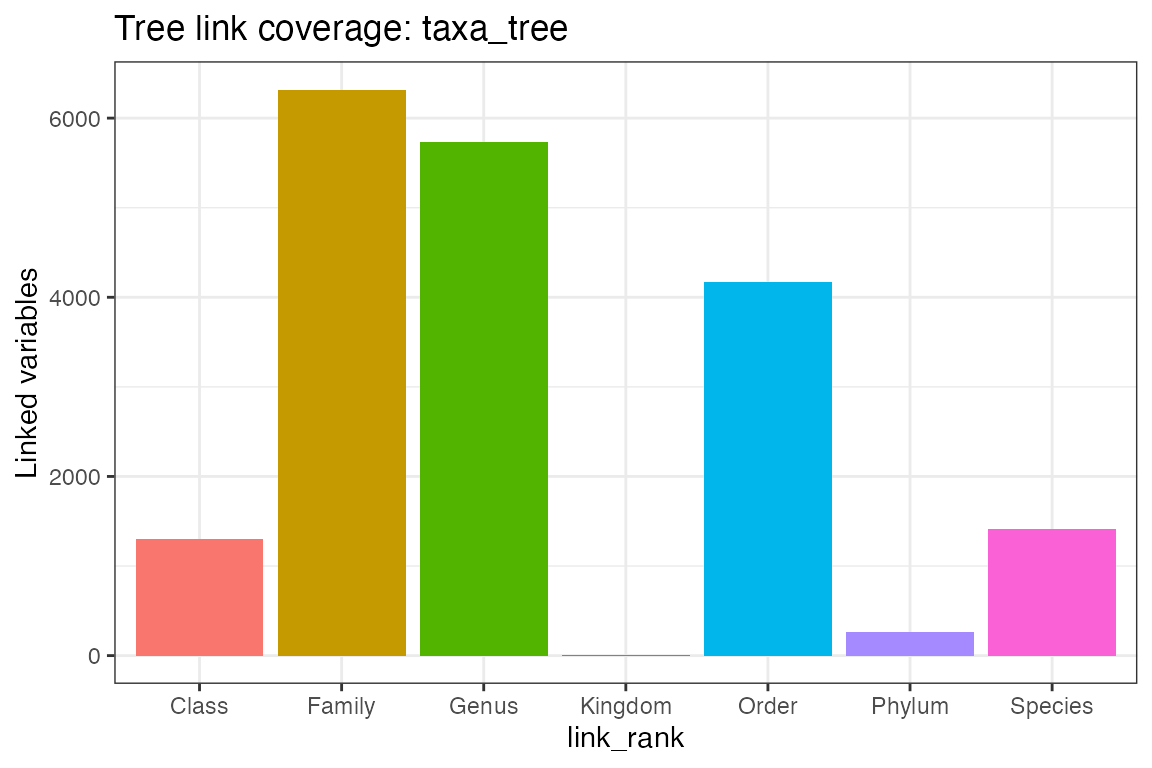
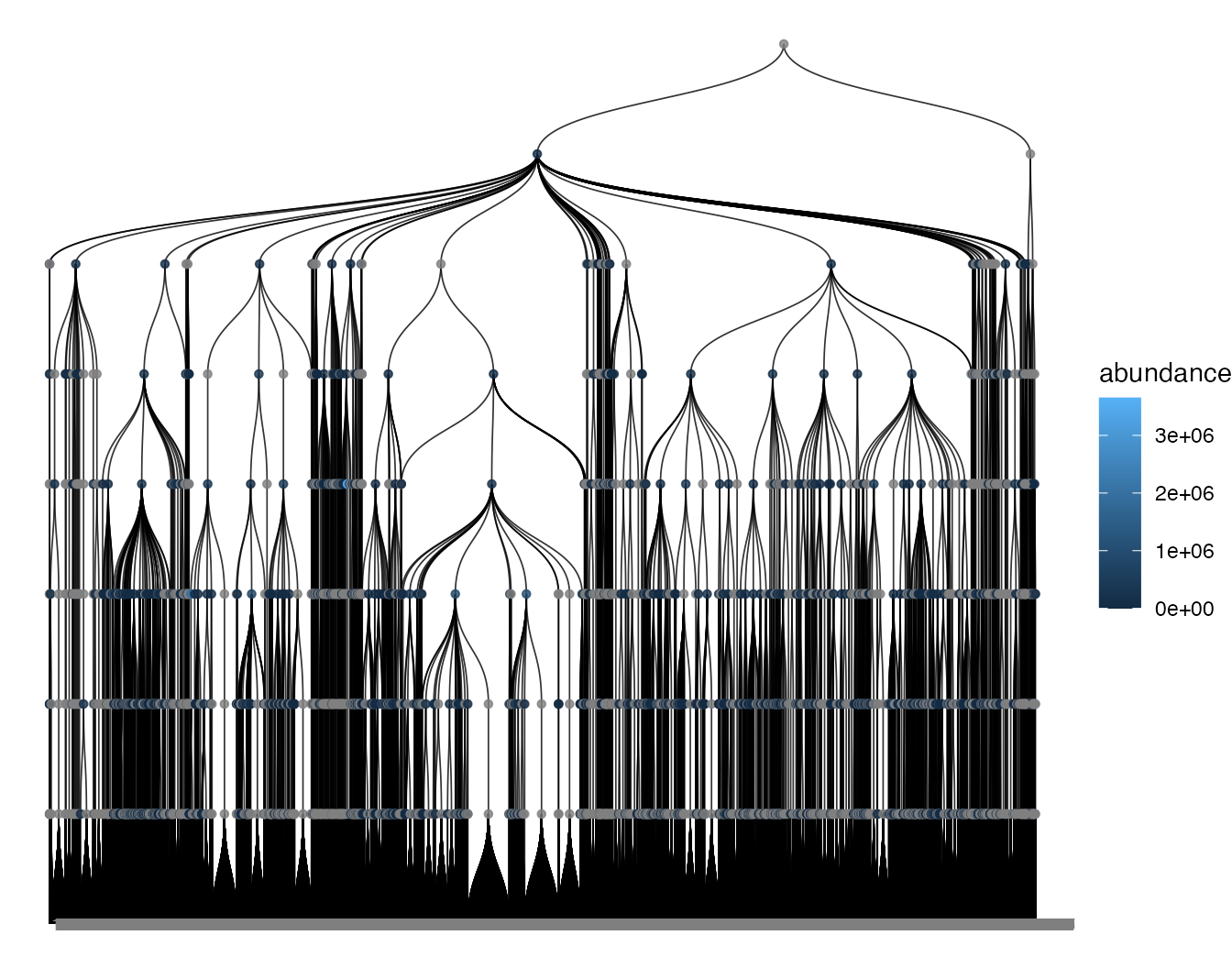
Plot the taxonomy tree with abundance mapped to nodes:
plot_tree(
  object,
  tree = "taxa_tree",
  color_by = "abundance",
  taxonomic_rank = "Phylum"
)
Align or prune tree attachments explicitly:
aligned_tree_object <- align_tree(object, tree = "otu_tree")
pruned_tree_object <-
  prune_tree(
    object,
    tree = "otu_tree",
    tip_label = object@variable_info$variable_id[1:100]
  )

length(
  extract_tree_data(
    aligned_tree_object,
    tree = "otu_tree",
    data_type = "phylo"
  )$tip.label
)
#> [1] 0
length(
  extract_tree_data(
    pruned_tree_object,
    tree = "otu_tree",
    data_type = "phylo"
  )$tip.label
)
#> [1] 0
If you load an older serialized object, refresh it to the current schema first:
object <- update_microbiome_dataset(object)Work with reference sequences
Add a minimal demo sequence set:
ref_seq <- Biostrings::DNAStringSet(rep("ACGT", nrow(object@variable_info)))
object <- replace_ref_seq(object, value = ref_seq)

length(extract_ref_seq(object))
#> [1] 19216
Export and import FASTA:
fasta_file <- tempfile(fileext = ".fasta")
export_ref_seq(object, fasta_file)

roundtrip_seq_object <- import_ref_seq(prune_ref_seq(object, variable_id = character()), fasta_file)

file.exists(fasta_file)
#> [1] TRUE
length(extract_ref_seq(roundtrip_seq_object))
#> [1] 19216
Export and import trees
tree_file <- tempfile(fileext = ".nwk")

export_tree(object, tree_file, tree = "taxa_tree", format = "newick")

tree_roundtrip <-
  import_tree(
    replace_tree(object, tree = "taxa_tree", value = NULL),
    tree_file,
    tree = "taxa_tree",
    format = "newick"
  )

file.exists(tree_file)
#> [1] TRUE
is.null(tree_roundtrip@taxa_tree)
#> [1] FALSE